
Finding Scholarly Sources
Your main goal when collecting sources for your research will be to find and use the most credible information available. Sometimes this means using articles from peer-reviewed journals, other times you will find the most credible information in other formats. It's your responsibility to decide what information is credible and suits the needs of your assignment.
1) Types of Information Sources
2) Identifying Credible Sources
3) Peer-reviewed Sources
Types of Information Sources
The following is a non-exhaustive list of potential information sources, including their typical process of creation/publication and some constraints or limitations to keep in mind:
- Website (Organizational/Institutional): Process: Created by organizations, institutions, government agencies, or businesses to present information about their work, policies, or services. May undergo internal review processes but typically not external peer review. Constraints: Authority depends heavily on the source organization's credibility and expertise. Can be updated easily but may lack publication dates, making currency difficult to assess. May present biased or promotional perspectives. Useful for official positions, statistics, and organizational information.
- Published Academic Book: Process: Builds on extensive research over multiple years, involving proposal approval, writing, review by experts, and formal editing and fact-checking by a publisher. May include indexing and bibliography verification. Constraints: The long publication timeline (often 2-5 years from conception to publication) means it is better for foundational knowledge, theoretical frameworks, and comprehensive topic coverage than for breaking news or the most recent developments. High credibility but limited currency.
- Peer-Reviewed Journal Article: Process: Authors submit manuscripts to academic journals where they undergo blind peer review by 2-3 subject experts, followed by revisions and editorial approval. The process includes rigorous methodology evaluation and citation verification. Constraints: Publication timeline ranges from 6 months to 2 years. Focuses on narrow, specific research questions rather than broad topics. Access may be restricted behind paywalls. Highly credible but can be inaccessible and technical for general audiences.
- Wikipedia Entry: Process: Content is crowd-sourced and can be created and edited in real-time by many contributors with varying levels of expertise. Changes are tracked and can be reverted by moderators. Constraints: Authority and expertise of contributors can be uneven. The open editing process requires careful verification of claims against cited sources. May be subject to vandalism or bias. Often a good starting point for research but rarely sufficient as a final source for academic work.
- Online News Article: Process: Written by journalists under deadline pressure (hours to days). Undergoes editorial review and fact-checking by news organization staff. May be updated as stories develop. Constraints: Prioritizes timeliness over depth; initial reports may contain errors later corrected. Varies widely in quality depending on news outlet's standards and resources. May reflect editorial bias or sensationalism. Excellent for current events but requires evaluation of source credibility and corroboration with other sources.
- Individual Web Content (blogs, podcasts, videos, social media, etc): Process: Created and uploaded by individuals with minimal to no editorial oversight. Can be published immediately after creation. May range from personal opinion to expert analysis. Constraints: Authority varies dramatically based on author's credentials and purpose. No formal review process means accuracy and reliability must be carefully evaluated. Can be highly subjective or promotional. May offer valuable insider perspectives or expert commentary but requires verification against more authoritative sources for academic use.
- Archival Record/Primary Source Document: Process: Original historical documents (letters, photographs, official records, artifacts, etc.) preserved in archives, libraries, or museums. May be digitized for online access. Undergoes archival processing including authentication, preservation, and cataloging by trained archivists. Constraints: Requires interpretation and contextualization; may reflect the biases, perspectives, and limitations of their creators and time period. Physical access may be restricted; digital surrogates may have limitations. Authenticity and provenance must be verified. Invaluable for historical research and firsthand accounts, but must be analyzed critically within historical context.
- AI-generated Overview/Summary: Process: Created instantly by artificial intelligence systems (such as search engine AI features) that algorithmically generate text based on training data, real-time web content, and the user prompt. No human authorship or traditional editorial review. Constraints: May contain factual errors, plausible-sounding but false information, or oversimplifications. Sources may not be clearly cited or verifiable. Reflects biases in training data. Sycophantic replies to user prompts may nurture user biases, or leave them unchallenged. All information must be verified against primary sources. Often not accepted for citation in academic work.
Identifying Credible Sources
You probably noticed that each format may or may not be suitable for your research, depending on your needs or context. Evaluating a source requires you to look beyond its format to understand how its authority is constructed and what its creation process implies about its message, quality, and utility for your specific need. Here are some key indicators to consider to help you evaluate the credibility of your sources. These are not strict rules, only general considerations. As always, exercise your critical judgement.
- Context: What kind of information do you need and what are you using it for? Does your project require authoritative academic sources, or should alternative voices be represented, or both?
- Author: Who wrote it? What are their credentials or background? Why is their view important? Do they have any biases that might skew their viewpoint?
- Publication Process: How did this source get created and published? Was it created quickly or slowly? How much independent editorial/academic review was involved?
- Audience: Who was the source created for? Does it use specialized vocabulary or plain language? Does the source pander to a particular group or viewpoint?
- Documentation: Does the author use other sources? If so, are they listed in a Reference List or Works Cited? Are these sources scholarly?
- Publisher: Who funded or published this information? Are they a College/University or scholarly association? Do they have a financial interest in the topic? Do they have any biases that might skew what they decide to publish?
If you’re not sure about one of your sources, ask your professor. They will be able to provide advice about which sources are most applicable to your research. In the end, though, it will be you as the researcher who will decide which sources to include and which to ignore. You'll need to be thoughtful and selective, and able to intelligently justify your decisions.
Peer-reviewed Sources
Some journals require that the articles they publish be peer-reviewed. This means that before the articles appear in the journal, they are reviewed by a panel of experts in the field of study. This panel is tasked with ensuring the article is of good academic quality.
While individual journals may vary, here is a basic summary of the peer-review process.
- Author submits article to journal.
- Editor conducts initial review.
- Editor contacts potential peer-reviewers.
- Reviewers conduct detailed review.
- Reviewers submit review and recommendation.
- Journal accepts or rejects article for publication, or accepts with suggested revisions.
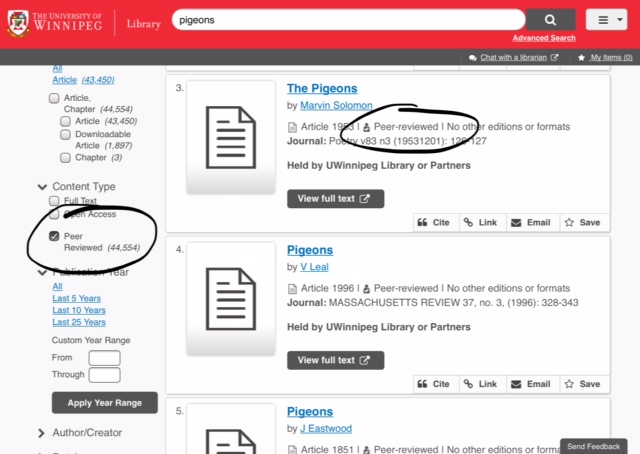
You can limit your search to peer-reviewed articles in most library databases.
Verifying Peer-review
You can verify that a journal uses the peer-review process using the Ulrich's Database.
1) Go to the Ulrich's Web Database (or browse there in the A-Z Databases List).
2) Search for the title of the journal.
3) Look for the referee's jersey icon. This means the journal is peer-reviewed.

It's important to note that not all the articles in a peer-reviewed journal will necessarily be peer-reviewed. Here are some examples of content that is not usually peer-reviewed, even when it's published in a peer-reviewed journal.
- Letters to the editor
- News items or communications
- Editorials or opinion pieces
- Book Reviews
If you require any assistance, feel free to contact us.