
Understanding Research Assignments
Before you begin researching and writing, I encourage you to spend some time understanding your assignment and preparing your process and workflows. For some of you, this will be your first initiation into the research process. In these tutorials, we will look at this process not as a linear checklist, but as a cycle of inquiry, exploration, and conversation. The goal is not to demonstrate a single, static way of doing research, but instead to help guide you toward a deeper understanding of research as dynamic and iterative. But, I'm already getting a little ahead of myself, so let's begin by looking at the assignment itself.
On this Page:
About Research Assignments
Most of your courses will require you to complete a research assignment of one kind or another. In general, the goal of a research assignment is to get you to gather information about a certain topic, analyze that information, and report what you’ve learned as part of a class presentation or research paper/essay.
However, a research assignment is not simply a set of rules to be followed; it is an open-ended exploration driven by intellectual curiosity. The requirements and constraints of an assignment provide the initial framework within which you can begin to ask complex questions, explore unresolved problems, and develop your own authority and expertise.
You can find useful information about the different types of research and writing assignments at the Online Writing Lab. The advice below should be helpful regardless of what type of assignment you're working on.
Deconstructing Assignment Requirements
Deconstructing your assignment is the first strategic step in formulating the meaningful research questions that will guide your entire project.
- Topic: Whether you are assigned a topic or choose your own, your initial topic (or topic area) will be preliminary. Look at this as your opportunity to ask key questions and identify "information gaps" that will eventually form the basis for your assignment.
- Type of Sources: Often, the assignment will ask you to use a certain mix of source types (e.g., "no less than five academic/peer-reviewed sources"). This requirement signals the expectation that you engage with the scholarly conversation around your topic, although certain topics may demand the use of other types of sources. What's most important is that you exercise your own critical judgement when deciding what sources to use and can intelligently justify your choices.
- Citation Style: There are many different styles for referencing your sources, including APA, MLA, Chicago, and CSE. These styles are more than formatting rules; they are the established grammar of a specific discipline or scholarly community. Using an appropriate citation style demonstrates your fluency with the community's practices and lends academic authority to your work.
- Length: The specified length of a paper or presentation is a practical guide to the appropriate "scope of investigation." This will help you determine how deeply to explore your topic and how much you'll need to narrow and refine complex questions into more manageable components. While longer assignments tend to require more time to complete, even shorter assignments can be time-consuming, so start early and be sure to set aside enough time to do the work well.
Conducting Preliminary Research
Below you'll find recommendations of resources and strategies to explore the library's collections and conduct preliminary research. However, success in research is determined more by the researcher's attitude towards the process than their use of any particular tool or strategy. Researchers like you (yes, you are now a researcher) need to be curious, flexible, open to alternatives, resilient when faced with difficulties, and willing to ask for help and advice when needed. No matter where or how you do your research, these dispositions will be your most effective tools.
The goal of your preliminary research will be to understand the existing landscape and formulate your initial questions. Here are four potential places/strategies to get started:
- Course outline/textbook: presumably, your initial topic will be related to the course. Look for any course materials, lecture slides/notes, or textbook chapters/sections that discuss your topic.
- Relevant book: a good book about the general topic area will allow you to get situated in all the related aspects and subtopics. Use the table of contents and index to find the most relevant sections.
- An encyclopedia article: the library has a large collection, both in print and electronic, of subject encyclopedias related to the major academic disciplines. Finding a relevant article in one of these can be an excellent starting point for developing your ideas. Even Wikipedia can be helpful at this stage, although, as always, be wary of any uncited or unvetted information.
- Literature/systematic reviews: the library search and databases allow you to find sources related to key words or concepts, but these results may be too hyper-specific to help with preliminary searching. Adding ("literature review" OR "systematic review") to your search can help you locate sources designed to provide an overview of the existing literature.
As you look at your preliminary sources, note any incomplete or unresolved ideas or concepts, points of controversy/disagreement, questions that spring to your mind, or anything else that piques your curiosity. These observations will give you specific points to enter the scholarly discussion, deepen your research investigations, and begin developing your own informed perspective on the topic.
Organizing Your Sources and Ideas
Before you begin searching for sources beyond these preliminary strategies, I'd like you to take a moment to get yourself organized and ready for the task of academic research. Keeping your thoughts and sources organized will be important to this process for two reasons: 1) it will help you to avoid academic misconduct, like plagiarism; and 2) it will make it much easier for you to understand and synthesize the existing research, see how different sources agree or disagree, and ultimately develop your own ideas and draw your own conclusions.
Here’s some advice to keep your readings, notes, and bibliographies organized:
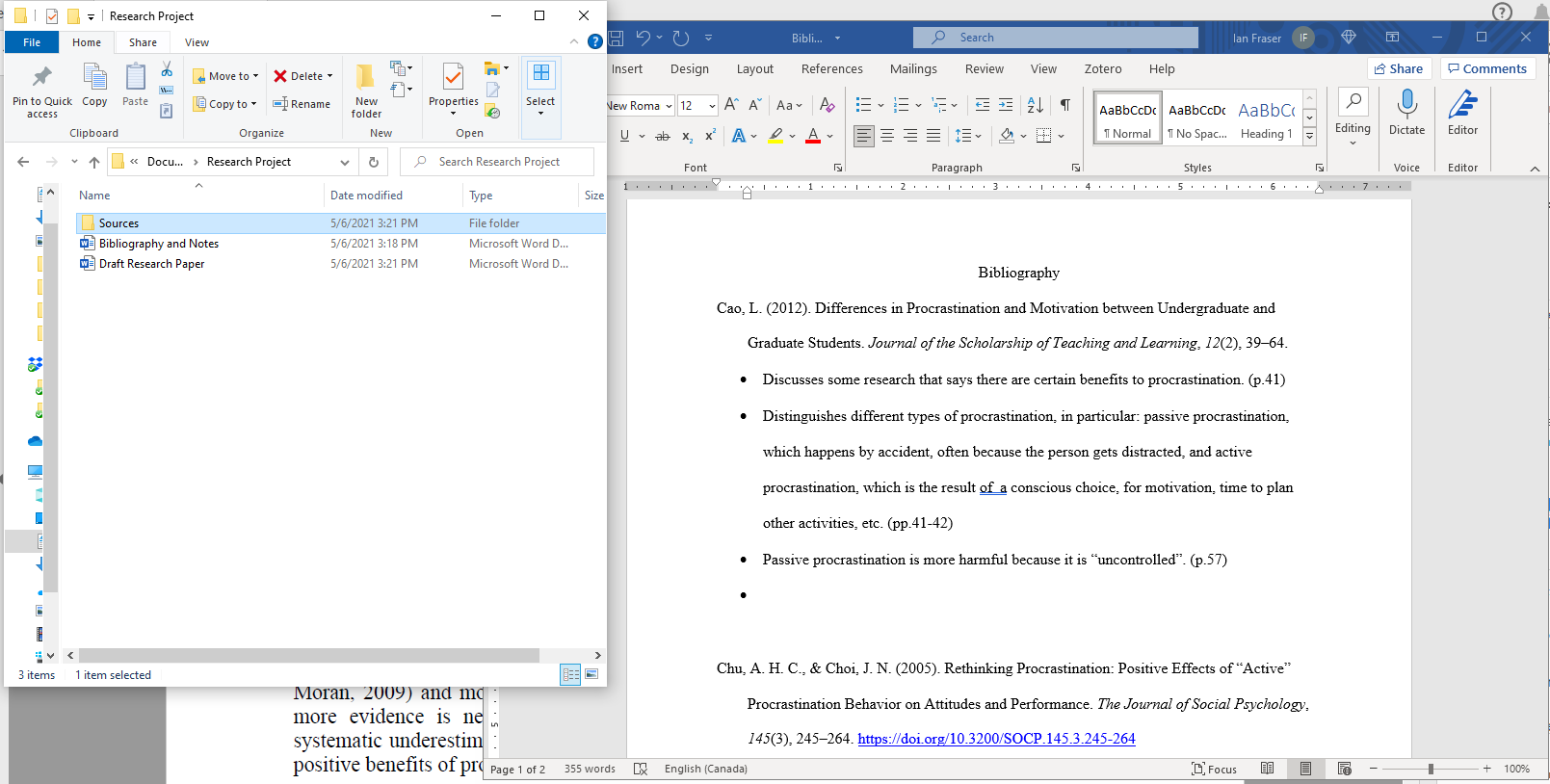
- Create a separate folder on your computer for each research project you’re working on.
- Place all your full-text articles (PDFs) in this folder.
- Create a complete bibliography entry for each of your sources (including books and other non-digital sources) and save the file to this folder.
- As you read your sources, take notes under the bibliography entry. Be sure to note the page numbers as appropriate.
Many students and researchers like to use a citation management tool to help keep their sources organized, and to create citations and references. If you're interested in this, you may want to have a look at this information about using Zotero, which is one example of a citation manager.